

Market Watch
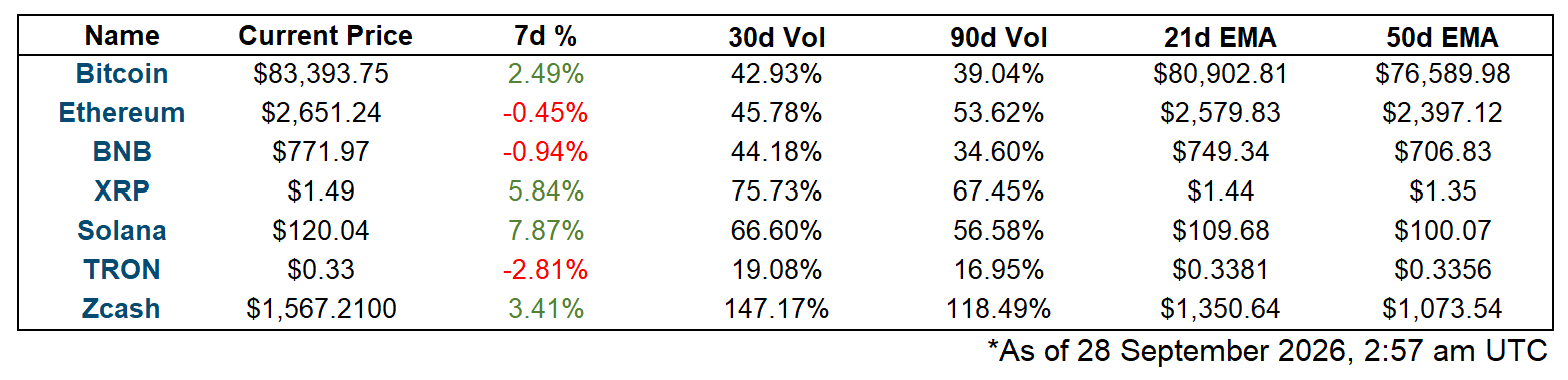
Things to Watch This Week (September 28 - October 2)
· Fed Tightening and Oil Swings Keep Markets Volatile
Global markets remained mixed as investors weighed expectations for further Fed rate hikes against sharp swings in oil prices. Crude fell earlier in the week on hopes for progress in U.S.-Iran diplomacy, then rebounded as geopolitical tensions resurfaced before easing again by Friday. Treasury yields remained elevated, with the U.S. 10-year yield briefly rising above 5%, while strong AI-related gains helped support major equity markets despite broader macro uncertainty.
Random Musing This Week
The CLARITY Act Stalls: What Comes Next for U.S. Crypto Regulation?
The CLARITY Act was designed to address one of the most persistent problems in the U.S. digital asset market: uncertainty over how existing financial laws apply to crypto assets and businesses. Under the current framework, the regulatory treatment of a digital asset can depend on how it was issued, sold and traded, creating uncertainty over whether it falls under securities regulation or commodities law.
This has also made it difficult for exchanges, brokers and token issuers to determine which regulator they should register with and what compliance framework applies to them. The legislation sought to draw a clearer line between digital asset securities and digital commodities, allocate jurisdiction more explicitly between the Securities and Exchange Commission (SEC) and the Commodity Futures Trading Commission (CFTC), and establish tailored disclosure and registration requirements for digital asset issuers and intermediaries. However, despite advancing through the Senate Banking Committee earlier this year, the bill failed to advance in the full Senate on September 15 after falling short of the 60 votes required in a procedural vote.
The bill ultimately ran into a number of unresolved policy conflicts. Crypto companies generally favored clearer and more tailored rules, arguing that applying traditional securities regulation too broadly could make it difficult for digital asset businesses to operate in the United States. Traditional financial institutions, meanwhile, raised concerns about the growing competition from stablecoins and crypto firms in areas such as deposits and payments.
Lawmakers also disagreed over whether the proposed framework provided sufficient investor protection, safeguards against illicit finance and protections against broader financial stability risks. Another major point of contention involved ethics provisions relating to public officials’ financial interests in digital assets. Supporters argued that the bill introduced meaningful disclosure and market integrity requirements, while opponents maintained that important loopholes remained. As a result, the debate became less about whether digital assets required regulation and more about how far a new framework should depart from the existing financial regulatory system.
The vote does not necessarily mark the end of U.S. crypto market structure legislation. The Senate could reconsider the bill after further negotiations, although additional compromise would likely be required before another vote.
In the meantime, the SEC and CFTC are expected to continue using their existing authorities to develop rules and guidance for digital asset markets. This means regulatory development will continue, but without comprehensive legislation, the longer-term framework will remain dependent on agency rulemaking and future congressional negotiations.
Recap of Top Stories (September 21 - September 25)
Top Story of the Week
SoFi Moves Its Entire $25 Billion Card Program to Stablecoin Settlement on Mastercard
[Stablecoin] [Banking] [Payments]
SoFi began settling card transactions on Mastercard’s network using SoFiUSD, its own dollar-backed stablecoin, on September 22. The full program, expected to exceed $25 billion in annualized volume, is moving onto stablecoin settlement.
SoFi is the first national bank to run live stablecoin settlement across Mastercard’s network. Merchants and acquirers see no change: they need not hold SoFiUSD or modify their systems, as conversion happens inside the settlement layer. The arrangement follows a March agreement. SoFi plans to extend the capability to other issuers through Galileo, its payments platform, letting additional banks and fintechs settle in tokenized dollars without building their own infrastructure.
Also, In Focus
CFTC Opens the Door to Stablecoin Margin and Tokenized Money Market Fund Collateral
[Regulation] [Derivatives] [Capital Markets]
CFTC staff guidance allows futures commission merchants to accept customer-deposited non-security digital assets, including payment stablecoins, as margin, and permits derivatives clearing organizations to take crypto as initial margin.
Four questions added September 24 let FCMs and clearing houses invest customer funds in tokenized forms of instruments already allowed under Regulation 1.25, including tokenized money market fund shares — blockchain-native collateral inside the existing customer-protection framework.
Federal Reserve Proposes Capital and Reserve Rules for Payment Stablecoin Issuers
[Regulation] [Stablecoin] [Banking]
The Federal Reserve Board issued two proposals implementing the GENIUS Act on September 24. Issuers would have to back tokens fully with permissible reserves — cash, Fed balances, insured deposits, Treasuries maturing in 93 days or less, and Treasury-backed repo — and redeem within two business days.
They also set standardized capital requirements for credit and operational risk and custody standards for reserve assets, and create a tailored application process for Board-supervised institutions. Comments close 60 days after Federal Register publication; GENIUS takes effect in January 2027.
ARK Invest Tokenizes Its Venture Fund With Securitize
[Tokenization] [Institutional] [Capital Markets]
ARK Invest is launching a tokenized share class of the ARK Venture Fund, a roughly $1.3 billion interval fund whose holdings include SpaceX, OpenAI, Stripe and Anthropic. Securitize will handle on-chain issuance on Ethereum, following an amended SEC order granted September 21.
Subscriptions can be made in USDC with a $500 minimum. The shares will not be exchange-listed and no secondary market is expected at launch, so the fund’s periodic repurchase offers remain the exit route.
Upcoming Market Events
September 30 - Korea Blockchain Week
October 7 - TOKEN2049 Singapore