

Market Watch
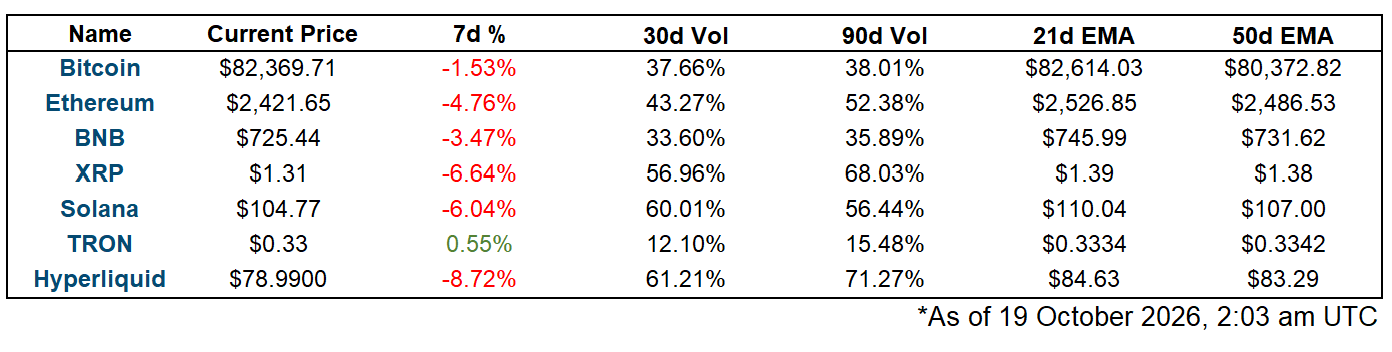
Things to Watch This Week (October 19 - October 23)
· AI Selloff Sends U.S. Tech Stocks Sharply Lower
U.S. equities suffered a sharp pullback this week as concerns over stretched AI valuations, heavy infrastructure spending, and persistently high borrowing costs triggered a broad selloff in technology stocks. The Nasdaq 100 fell roughly 5.5% for the week, its steepest weekly decline since April 2025, while semiconductor and AI-related names led the losses. Despite hotter-than-expected inflation and continued oil volatility, investors moved into U.S. Treasuries, pushing the 10-year yield back toward 5.1% as risk appetite weakened.
Random Musing This Week
Quant and the U.S. Banking System: What Is Driving QNT’s Recent Rally?
Quant (QNT) has recently drawn significant market attention following its selection by The Clearing House (TCH) as the technology provider for a new U.S. bank-led tokenized deposit network. Following the announcement, QNT rose from roughly $60–70 to above $350 at its peak in late September.
1. What is Quant?
Quant is a blockchain infrastructure company focused on interoperability, enabling different blockchains and traditional financial systems to communicate with one another. Its core technology, Overledger, functions as an interoperability layer rather than as a standalone blockchain.
Through APIs, financial institutions can connect their existing systems to multiple distributed ledger networks without rebuilding their infrastructure for each individual blockchain. Quant primarily targets banks, financial institutions, and capital markets, where fragmented blockchain networks can otherwise make large-scale adoption difficult.
QNT is the utility token associated with the Quant ecosystem. It can be used across Quant’s products and services, including for platform access and payments.
2. What is The Clearing House building with Quant?
On September 24, The Clearing House selected Quant as the technology provider for its On-Chain Money Initiative, a network designed to allow U.S. financial institutions to clear and settle tokenized commercial bank deposits on-chain.
TCH plays a significant role in U.S. financial infrastructure. It operates payment networks including RTP and CHIPS and processes more than $2 trillion in payments each day. The initiative is supported by major financial institutions and is expected to become available to participating banks in the first half of 2027.
Under the initiative, banks would issue digital representations of commercial bank deposits that can move across blockchain-based infrastructure. Quant will provide the interoperability, orchestration, and transaction management layer needed to connect these tokenized deposits with existing financial infrastructure. If successfully implemented, the network could support 24/7 settlement, automated payments, programmable transactions, corporate treasury management, cross-border payments, liquidity management, and digital asset settlement.
The significance of the partnership therefore extends beyond a limited blockchain pilot. If the initiative scales across the U.S. banking system, Quant could become an important infrastructure provider connecting traditional bank money with tokenized financial markets.
3. How could this affect QNT’s price?
The initial market reaction appears to have been largely expectation-driven. Following the TCH announcement, investors quickly repriced QNT as a potential beneficiary of institutional tokenization, driving the token up more than 200% within roughly a week. The partnership also provided unusually strong institutional validation for Quant. Unlike many crypto-native partnership announcements, TCH operates infrastructure that sits at the core of the U.S. banking system, which significantly strengthened the market narrative around Quant’s institutional adoption potential.
Over the longer term, however, the impact on QNT will depend on how Quant’s technology is commercialized and how much of that activity creates direct demand for the token. Greater adoption of Overledger could increase demand for Quant’s services, while QNT can be used to access and pay for parts of the platform. In that sense, broader network usage could support additional utility demand for QNT.
However, Quant also allows certain platform fees to be paid in U.S. dollars, and TCH has not stated that participating banks will be required to purchase or hold QNT directly. The TCH partnership substantially strengthens Quant’s credibility and demonstrates that its technology can be deployed within institutional financial infrastructure. For the recent QNT rally to be supported by fundamentals over the longer term, however, investors will need to see whether growing use of Quant’s infrastructure ultimately translates into meaningful and recurring demand for QNT itself.
The partnership therefore represents an important milestone for Quant, while also highlighting a broader issue in altcoin investing: the success of a blockchain technology does not automatically translate into equivalent value for its token. QNT’s longer-term investment case will depend increasingly on whether real-world adoption of Quant’s infrastructure can generate sustained utility and demand for the token.
Recap of Top Stories (October 12 - October 17)
Top Story of the Week
Visa Moves USDC Funding for Cross-Border Payouts into Commercial Production
[Stablecoin] [Payments] [Infrastructure]
Visa put USDC prefunding for Visa Direct, its real-time payouts network, into commercial production on October 15, with Inyo Global as the first processor to offer it. Businesses can fund cross-border payouts to more than 180 countries in USDC in near real time, including when traditional funding windows are closed.
The launch follows a year of testing. Visa began piloting stablecoin prefunding with USDC and EURC in September 2025, and a seven-day USDC trial with Lloyds earlier this month settled $750,000 in payment obligations, with funds reaching Visa in under an hour, including over a weekend.
Also, In Focus
Australia’s ASIC Sets Out Standards for Its New Digital Asset Laws
[Regulation] [Asia-Pacific] [Custody]
The Australian Securities and Investments Commission opened a consultation on October 15 on implementing the Corporations Amendment (Digital Assets Framework) Act 2026, which brings digital asset platforms and tokenized custody platforms under Australian financial services licensing.
The proposals set asset-holding, transaction and settlement standards and net tangible asset requirements, and would streamline licensing for existing licensees. Feedback is due November 27, and the new laws take effect on April 8, 2027.
Polygon Labs Completes Coinme Deal, Gaining Licensed U.S. Payments in 48 States
[Stablecoin] [Payments] [M&A]
Polygon Labs completed its acquisition of Coinme on October 14, part of a $250 million deal announced in January that also covers wallet infrastructure firm Sequence. Coinme brings 37 state money transmitter licenses, 11 exemptions and FinCEN registration, together covering 48 U.S. states.
Through its Open Money Stack, businesses can accept funds, settle in stablecoins and pay recipients in local currency. Early customers include Tazapay, Mesh, Toku and Kira, with the unified integration in technical preview for select customers.
Cross River Bank Adds Ripple’s RLUSD Stablecoin to Its Core Banking Platform
[Stablecoin] [Banking] [Payments]
Cross River Bank added Ripple USD (RLUSD) to its core operating system on October 15 as a payment rail alongside traditional ones, letting fintech clients move between U.S. dollars and RLUSD and settle cross-border payments and treasury movements 24/7.
Clients can also reach ACH, wires and real-time payments through the same platform and API. RLUSD is issued on the XRP Ledger, where Ripple says transactions settle in three to five seconds.
Upcoming Market Events
October 20 - SEC comment deadline on the new crypto regulation
October 27-28 - FOMC meeting